Home Forum Photos Showbiz Classifieds Forex Rate Archives Contact Us RSS
 |

|
 |
 |
 |
 |
 |
 |
|
 |
 |
 |
 |
|


MORE News Headlines
Manila Standard
Daily Inquirer
Philippine Star
Manila Bulletin
Manila Times
Asian Journal
Filipino Express
Malaya Online
Daily Tribune
ABS-CBN News
GMA News
TV5 Interaksyon
Solar News
Philippine News
Kababayan LA
MindanaoTimes
Sun Star
Negros Chronicle
Bohol Chronicle
Advertisement

Yehey Search
Phil. Senate
Phil Hse of Rep
Peso Exch Rate
Buy & Sell
Filipino Channel
Phil History
Phil Business
Phil Basketball
Make it Cebu
BuWorld Online
PHL News Links
[ads/160x600_06.htm]





|
|

 he rice shortage that the Philippines is currently
 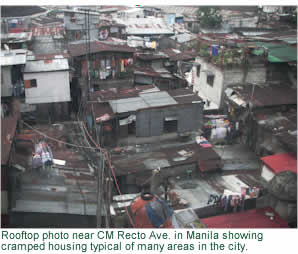 experiencing is the result of its exploding population. The country is quickly running out of land and all other needed resources to house, feed, educate, and otherwise care for its 83 million Filipinos.
A statement from the European Union, which was part of its 2008 Philippine Development Forum says that: "Continued rapid population growth in the Philippines is draining health and economic resources and slowing down economic growth. It also threatens the sustainability of rural livelihoods and is inexorably destroying the remaining natural forest and marine habitats. The poor are paying the highest price, both individually and collectively. The European Union therefore calls for the effective implementation of a comprehensive national family planning policy, promoting access to family planning methods."
In trying to understand the Philippine population problem, it becomes apparent that the problem is more pronounced the lower the social rung one goes. The poorest of the poor tend to have more children compared to the middle and upper classes of society.
And their logic behind the large family is this: the more children you have the greater the chance that one or more of them will become successful enough to pull you and the rest of the family out of poverty. In addition, parents in the Philippines also look to their kids as the ones who will take care of them in their old age. Thus, the more kids they have, the more caretakers they will have in their twilight years.
 Add to this mix the stand of the Catholic Church against all forms of artificial birth control, and you realize that it is almost impossible for a weak and hobbled administration like the Arroyo administration to take any concrete steps to stem the country's runaway population growth. For any foreigner or balikbayan, the sheer number of people in Metro Manila is enough to overwhelm the senses. Everywhere you look, you see hundreds of people in the streets, at all times of the day or night. Piles of garbage, polluted sewers, smog from cars, trucks, and jeepneys, and now rice and other agriculture products are no longer able to keep up with the increasing demands of an exploding population.
It is not going to be easy, and it is not going to be quick, but something has to be done to to bring the Philippine's runaway population growth under control. We owe it to the future generations of Filipinos who may be forced to live in poverty and squalor. We owe it to the millions of young graduates who cannot find jobs here at home and are forced to work overseas. We owe it to our children who expect us to fix the problem and not just pass on a bigger problem to them.

| [ads/300x250_09.htm] |
 |

|

|